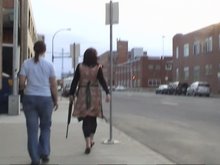
Common Ground, Joshua Schwebel Photo: Emma Waltraud Howes
To walk in another’s shoes is an empathetic gesture. Joshua Schwebel takes this anecdote to its literal extreme and constructs wearable sculptures made of found shoes that are conjoined at the sole. Josh invites people to wear the shoes and engage with him in various activities such as walking, dancing and exercising. He also invites people to exchange their shoes with his own and walk though the city.
I meet up with Josh in an exercise gym in the downtown core. It is a trendy and spacious training centre. Josh meets with the manager, tells her we are from Visualeyez, and asks if we can exercise on the treadmill wearing the shoes. He notes that we will be videotaping. Somewhat surprisingly, the manager doesn’t find his request strange and generously agrees to let us use the gym as we see fit, free of charge.
This is my second time participating in Josh’s project. Last Saturday I danced with Amber, and also in a triangular connection with Josh and Amber at the Roost Club. Today I try on a different pair of conjoined shoes with Josh. We sit on exercise bikes and attempt to push the pedals wearing absurdly inappropriate shoes.
Common Ground, Joshua Schwebel
Video Tagny Duff
When I push forward, his foot resists my force. My other foot struggles to maintain balance. I try to relax into a rhythm with the least resistance. But even then, Josh’s foot slips and throws us both off balance again. I concentrate on finding the movement of his foot. I wait. I let go of waiting. Then, somehow we feel the movement continue and we are cycling. Something has happened in the lag between feeling like falling off the bike onto the cement floor below, and falling into an unfamiliar sense of balance. This balance relies on interdependence with Josh’s movement. The sense of ground shifts. My own internal sense of balance and horizon line is fundamentally reconfigured. I feel like I am simultaneously falling and sitting.
Josh is concerned with the often-imperceptible negotiations that we encounter between self and other at the level of these physicality-challenging encounters. Proprioception—the internal sense of the body’s movements correlating to its external positioning through muscular sensation - is an interest of Josh’s, and is the sense that he activates in these encounters. The site where the events occur are not as important as are the sensations experienced between Josh and the people wearing the shoes. It is the sense of struggle, the negotiations of dependence and interdependence that produce discomfort, that are evoked. The lag becomes a site of encounter. This lag is in-between the time when one’s body moves with another and when one consciously is aware of the movement.
Josh’s work suggests that the relations we encounter and produce within the city are not external from and of the body. The city is not only an external structure that we wear on our bodies, but it is one that our bodies create in relation. In this case, my relation to the city is created through the movements of our interdependent bodies. I think of Lori Weidenhammer’s ongoing interventions from the “Madame Beespeaker Project”, and recall her explanation of how bees navigate their relations between each other and the hive through the use of pheromones. I think of how birds flock together to form interdependent migration patterns. Josh’s piece also alludes to the potential for humans to navigate with one another through the city via the muscular dimensions of the human body. In his presentation last night, he noted how his physical orientation and sense of balance shifts when encountering a new city, or a new acquaintance. Then the balance stabilizes and the ground solidifies under his feet. Between these disorienting (and uncomfortable) shifts, he learns to navigate. Common Ground facilitates the potential for participants to move through the city as much as create new ways of moving the city.