Showing posts with label Sound. Show all posts
Showing posts with label Sound. Show all posts
Saturday, May 26, 2007
Marc Couroux and Juliana Pivato, The Fetish Character of Music and The Regression in Listening.
Marc Couroux and Juliana Pivato, Video: Couroux and Pivato
The Fetish Character of Music and The Regression in Listening.
The sound ecology of each cityscape is littered with prerecorded and live ambient sound. The continuous presence of these frequencies is filtered out through selective attention, and often goes unnoticed. Often the visual is privileged as the sense of navigation, and the aural is disregarded as background or unnecessary excess information. However, the aural dimension of urban life has the potential to move bodies through spaces. For example, muzak, original and remixed versions of popular music, is a staple of urban centres. It bleeds from shop windows and mall entranceways. The constant spillage of ambient music harmonizes with the sounds of mall shoppers and street sounds. Muzak is slyly insinuated into corporate spaces to lubricate the movement of bodies. Pedestrians are soothed into contemplative window-shopping. The steady drone of muzak is intended to deter street loiterers from hanging out. It plays in the background and blends into the sounds of cars driving by, of people conversing.
Juliana and Marc roam around the downtown core in a “performance- van” – a nomadic studio- where they repurpose muzak for passersby. Curtains are strung up around the windows of the van to hide the process of production. The visual effect renders the van as a kind of inaccessible shelter. Marc and Juliana take 4 fragments, randomly generated by MAX (a computer program) from 40 Carpenters’ songs, and attempt to “smooth them out”. Marc works on the keyboard and Juliana sits with headphones and a mic that is amplified. The speakers blast the live remix of the fragmented music emitting a lyrical form of music-muzak out from the van window. This blends with the sounds and muzak that circulate around the outer parameters of urban centres, like The Bay Department Store, Shoppers Drug Mart and other such places.
In order to locate the nomadic van, Marc and Juliana have set up maps of locations and times accessible through their blog. People are invited to find the van and encounter the soundscape Marc and Juliana create. Sometimes they are found, other-times not. Like many other works in the festival, this piece is not intended for an invited audience.
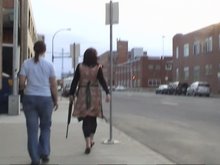
The visual cue of the curtains in the van attracts more attention than the loud oddly repetitive muzak. I find it after wandering around for twenty minutes. I hear the loud sound of the Carpenters’ music and see the van across the street from The Shoppers Drug Mart on 102nd Street. At first glance, it appears as though someone is camping out in their car and listening to a cd that is skipping. Some people stop to see if there is anyone in the van. They might see Marc playing the keyboard through a crack in the curtain. Most people just walk by. The subtle articulation of the sound performance is barely perceptible. Like Emma Howes’ performance, Marc and Juliana also seek to de-emphasize the proscenium and the traditional staging of the performance of music, in order to amplify its trace. In the attempt to de-emphasize the staging, another staging occurs. In the context of Edmonton’s current media focus on the tent squats and growing issue of homelessness due to rising housing costs, the van becomes a display of nomadic shelter. This is further evidenced by the fact that they rent parking space for hours at a time in order to both rehearse and generate muzak for incidental audiences.
When I walk towards the van I am taken by the way the motion and speed of my walking gait is implicated in the growing amplitude of the sounds emitted from the van. My motion determines the volume of Juliana’s singing voice. As I walk past the van, the level increases. The frequencies are reverberated against the cement enclave of the City Centre façade. If I didn’t know that the van was part of the performance, then I might think that the music was coming from a speaker on the building. I look up to the cement ceiling overhangs and search for outdoor speakers, and find none. I sit on a ledge just across from the van and listen. A sentence is repeated over and over. This is not the conventional melodic repetition of chorus lines forming the structure of a popular song. This original and live remix of oddly familiar lyrics and melody is as soothing as it is irritating. I close my eyes and listen for rhythm in the glitch. I discern the sounds of the cars passing by from the flow of this madly repetitive phrasing. I try to discern the music from the ambient- as figure and ground, and realize that this muzak is embedded in the ambient environment. Rhythms that Marc and Juliana create play with the rhythms of the continuous flow of motion in the streets. These are not “dotted rhythms” as Juliana explains in one of her postings on their blog. There is difference created in this repetition. The phrase takes on another form through each re-articulation.
They are not performing for the audience, but inserting an expanding field of unexpected encounter with the frequencies we travel through everyday, perceptible and imperceptible as sound or noise. They don’t want to perform for people, or have people encounter the work as performance. Rather it is the body moving through the aural field and moving the aural field that is the performance. As each body encounters this differently, it becomes impossible to locate the “place” of this performance.
The work illuminates a substrate of time-space that we move through and create in the city, that is rarely consider as a site of performance. Often we think of site-specific work as having to take place in a space or place, at a certain time. The definition of site connotes “a location”. But in this case, I encounter an auralscape that seeps through the parameters of the the visual markers of place. When the van is no longer in my field of vision, the soundscape Marc and Juliana create becomes ubiquitous with ambient sounds of the city. I cannot locate the “place” of this aural encounter on an X/Y axis, even though they created a map to direct me to this area.

Sunday, May 20, 2007
Jackson 2bears, Iron Tomahawks
Iron Tomahawks, Video and VJ performance Jackson 2bears
It is serendipitous that Jackson 2bears VJ’ed and brought the club context to Harcourt House hours before we found ourselves reversing the context, by bringing art to a club and dancing to DJ’ed music later on at night in Joshua Schwebels shoes. ( See Part 1 Morning discussion). The presence of VJ performances, most often experienced in club settings, is becoming increasingly more visible in performance art festivals.
Last night The Iron Tomahawks By Jackson 2bears was presented at Harcourt House in partnership with Latitude 53 and Visualeyez. This live performance utilizes digital encoded vinyl and software developed by the artist to mash-up and remix found film and video images of Native stereotypes ( Ie. White male actors dressing up like “Indians” from Hollywood films and also anthropological studies of Native dress and dance). Jackson 2bears remixes and reappropriates media images depicting Native stereotypes as a both a critical intervention into and “ a self-reflexive path of engagement with his native heritage”. (Noted in the festival program).
During the performance the audience sits on chairs on the edge of the exhibition space. Club lights strobe through the room, and a large screen displayed the mixed video. Jackson stands behind a table and a set of turntables, mixing throughout the performance. Some audience members comment on how it is staged like a high school dance or local gymnasium performance. Irene Loughlin notes that it reminds her of inner city gymnasium or community performance venues. Interestingly, no one dances, even though there is a large empty floor in the centre of the room. In the context of the Harcourt House, the event functions as a form of storytelling or a video presentation consisting of a 28 minute VJ mash-up remix of archival film and video material.
Technically speaking, the integration of video image and rhythmic beats is well crafted and performed live the use of the digital-encoded vinyl and custom made software give the mix a quick and smooth correlation between audio and image. See a short clip from the performance above.
One of the criticisms that often surfaces around the performance of DJ/VJ mixing is that the convention of display and staging is rarely critically considered. Performance art audiences have come to expect a conceptual engagement with the audience/performer relationship. Given the context of the festival, one that is very much about site-specificity and audience-performer relations, the site where the mixing occurs also becomes integral to the performance. In this case, the audience is left unsure of how to engage with the work. Do we dance, as if we are in a club? The chairs set up in the room, suggest to the audience that it is expected that we sit and watch. If I had been at a club, I would have been inclined to dance—but as it was, I would have been the only one on the room and then I would be implicated as a “planted” performer-so I didn’t.
Perhaps it is the nature of the introduction to the event that added an air of austerity and sobriety to the context. The directors of the galleries made a point of thanking all the funders, the city counselor (who was in the audience), noting how important it is to prevent racism against Native and First Nations People. While this is certainly necessary, the focus on first nations representation as a highlight of the festival was extensive and disproportionate to the full scope of the artistic expression of Jackson 2bears performance. This may have more to do with the site specificity of the Harcourt House as a venue that relies on government funding that requires specified allocation of funds towards diversity initiatives. While it is necessary to insure that moneys are allocated to artists traditionally underrepresented in the arts, the need to insist that this be the main point of focus rather than the work and ideas brought forth by the artist is disconcerting. It is for this reason that the context and site of the performance was perhaps more somber than what might have been intended within the delivery of the performance.
Jackson 2bears seeks to re-appropriate stereotypical images by decoding and recoding them. He changes the visual syntax and the stereotypes are reordered through repetition. Deleuze makes the case for difference in repetition, where movements that are reappropriated bring with them a shift or drifting. Others disagree with this, like Tanya Lukin-Linklater one of the artists who performed the first night, who commented to me that the tactic of appropriation does not change the stereotypical representation of First Nations People. Some images—like those of the Pow Wow are sacred, she notes. I wonder at the site of performance in relation to the images and sound---how might the frame of presentation be recoded and shifted to confront the desires and promixity of funders, audience and performer? How might this engage a politic of (re)appropriation that both challenges stereotypes and entices audiences to share in divesting images of racist inflections?
Subscribe to:
Posts (Atom)