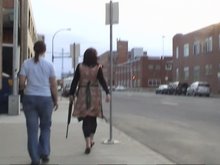
From left to right, Juliana Babaras, Todd Janes, Irene Loughlin and Tagny Duff
Last night was my first opportunity to meet and greet all the artists and local folks at the very stylish artist-run centre, Latitude 53.
Local Edmonton-based artists Tanya Lukin-Linklater, T.L. Cowan & Mickey Valley, and Lance Mclean open the festival with a diverse series of performances. The artists provide a local context- a necessary component for the theme of the city.

Tanya Lukin-Linklater, photo Jessica Tse
Tanya Lukin-Linklater, a local performance artist featured in last year’s festival who incorporates Alutiq dance, performance and installation, starts the evening with a performance that touchs upon the current issue of homelessness in Edmonton. Given the current boom in Alberta’s economy and the mass migration of people across the country moving to find employment, the reality of rising rental costs, and reduced funding for missions and shelters, (issues often underreported in the media) the performance is quite pertinent. Her performance takes place on the outdoor patio of Latitude 53. Carrying garbage bags and blankets, she walks to a water faucet and sits down next to it. Taking a handkerchief, she turns on the water and dips it in before wiping her body with the damp cloth repetitively. This, she later told me, referenced an article she recently read in the paper about a women living in Edmonton who has been sharing her outdoor faucet with people who do not have access to clean water. Soon, she turns the water off and stands up, grabs the garbage bags and walks to the other side of the patio. Laying down a tarp, she then proceeds to take out “Five Alive” 2 litre juice boxes from the garbage bags to build a wall around her in the shape of an igloo. Lying down in this makeshift shelter, she moves in such a way to break the wall, sitting up stiffly and issuing low, truncated throat singing.
 T.L.Cowan, photo Jessica Tse
T. L. Cowan expands on the spoken (and unspeakable) rituals expressed in the minefield of personal relationships enacted in urban centres. A staple of the spoken word festival circuit, Cowan presents a provocative three-piece monologue with soundscapes by Mickey Valley. Cowan smashes through sexual stereotypes and embraces the subtle and vast modes of sexual behaviour, intimate relations founded on fear, obsession and mania. Cowan delivers three separate, yet interrelated, carefully crafted monologues. They intertwine humour with explicit observations about the struggles embedded in maintaining and developing relationships with friends, families and lovers in various urban contexts. She later tells me that such risky content is not welcome in other spoken word festivals where audiences expect artists to follow conventions of entertainment culture. Cowan notes that audiences at performance festivals are open to experiencing discomfort and fear and are willing to subvert expected conventions of audience behaviour- such as mandatory clapping at “the end” of a performance. (Before she started the performance, Cowan asked the audience to refrain from clapping in between the three sets of monologues).
 Lance McLean, photo Jessica Tse
Also exploring rhythms of fear and provocation, Lance Mclean places the audience in the role of participant. As we walk into the gallery, we see a body with its head encased by a white plinth. The audience is invited to use a large handsaw to cut through the plinth on a line located (dangerously) near the covered head. The first cut takes time. Audience members take turns sawing. The relations among the participants shift as the energy levels ebb and flow. Some choose to help hold the plinth to aid the process of sawing. Others egg people on to share the labour. Most stand by and watch closely. Once the first half of the plinth is sawed, the cell phone in the bodys’ (Lance’s) back pocket rings. Todd Janes grabs it and answers. A voice tells him to ask people to cut on the second line marked on the plinth. Some members of the audience take action and grab additional plinths and set up a makeshift sawhorse to help speed the process of cutting through the second line. When that is done, people clap, somewhat grateful that the process is over. Then a planted participant proceeds to direct the body (with the head still in the plinth) to lie on the floor, as he continues to cut very dangerously close to the head. So close, in fact, that I am seriously concerned that my first aid classes are going to come in handy. There is a moment when I think that it is my responsibility to stop the process for the sake of Lance’s safety—yet, I do nothing. I watch as Lance’s head is freed from the plinth, and he walks out of the gallery.
The sense of suspension, impending accident and of a lag in time proliferates all the events. A fitting prelude for the rest of the festival perhaps. As an audience member I experience and feel the affects of the performances. I hold my breath. I shift the weight of my body while sitting, standing and leaning. I strain to watch. I am uncomfortable- in a productive sense. When Tanya sings, the hair on my arms stands up. I feel sick. When T.L. talks about being obsessed with pain and trauma, I uncomfortably shift my sitting position. When Lance puts himself in such danger, I experience back pains. At this point, time takes on a different kind of duration. It speeds up and slow down. My concentration shifts from intellectual focus to abstract sensations.
My memory of conversations and details that occurred from last night are not so clear. In retrospect, the evening is becoming something else. I know I have forgotten details and reconstructed events according to my faulty and fragile memory. (In fact, my short term memory is notoriously bad—but thankfully I have a vivid long term memory. Not a useful quality for immediate blogging, though). This lag in memory plays a major role in documentation and writing on performance in general. Things get omitted, forgotten, overlooked and, ultimately, recreated. This fact, I am sure, will be ever present in upcoming posts through the next nine days of the festival.