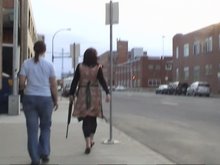
Sara Wookey, Walking Edmonton
Sara Wookey’s walking performances prompt encounters with the city as a form of memory. For two days she invites people to enact a walk through the city. However, it is not necessarily the walk that is the arena of this “performance”. It is in the informal conversations with walkers after their trip that facilitate a performance in and through retrospect. The remembering and telling of events becomes exaggerated and personalized through informal exchange of memoirs. The city, in this case becomes one of memory constructed through future recollections of past experiences.
I start at the gallery. On the reception desk there is a sign that gives me an option to choose one of two papers that are folded and stapled. I choose the one that says “Directed Tour”. It invites me to take a 45 minute walk through the city. The directions tell me to walk continuously and if I reach a red crosswalk light, to cross the other side. So I leave the gallery and the tour begins.
I wander out of the gallery and walk towards Jasper Street. I relax. I have time. I give myself over to the directive constraints of walking for 45 minutes. This is strangely comforting. For the last week I haven’t had the time to wander the city. Now I relax and feel the sun on my skin and hear the conversations from people I pass by. I find myself stumbling upon the river shortly after walking through the downtown core. I walk up and down a steep set of stairs and feel my heart rate race. My mind wanders and I forget that I partaking in “a performance”. When I get back to the gallery, I realize that I have not followed the directions since I often stopped at stoplights. I think about it some more and realize that standing still is to be in motion, so perhaps I haven’t unwittingly corrupted the directions.
Walking Edmonton, Sara Wookey
Video by Tagny Duff
During the walk I hold my video camera and put it on 6 second interval record. I am not sure if I will even use the footage. I forget about the camera. When I look at it later I find it amusing that it evidences my stillness while waiting for the street lights to turn green. The pixellated quicktime video creates a different sense of rhythm than the one I experienced on the walk.
When I return, I enter back through the gallery. Sara has set up a map of Edmonton with an index of different coloured pins, each corresponding to particular signification. An orange pin connotes when something memorable occurred. A red one is noted as referencing “where you felt desire”, and a white one marks when you stopped performing the walk. People have indexed their experiences according to these markers and pinned them on the map to correlate where “it” happended. Participants have also hand written thoughts, drawings and notes based on their responses to walks onto the wall of the gallery.
My immediate response was to resist the placing of my experiences on the map. Why qualify, archive and index my sensations on a grid? For some time, that I cannot fully remember, I was off the grid. Drifting. I wandered. I was walking in the city following constraints facilitated by the artist. However, other events and sensations occurred outside of those parameters. I thought about my mother, wondered if my visa payment had gone through yet, enjoyed the sunny warm weather, watched as two people walked slowly down the long steps to the river while complaining about low back pain, and noticed a man sleeping on the bench at the river lookout point.
I meet with Sara at a coffee shop and we continue to talk about my experiences and thoughts about the walk. She tells me that she has been conducting informal follow up discussions with most of the walkers/participants. Similar to our talk, the other conversations she has had tend to be casual and informal. Stories are told and exchanged. This is as much a part of the walk, it seems, as the walk itself. The remembering of the walk becomes the dislocated site of “the performance”. The ritualistic exchange of conversation between strangers and acquaintances becomes, not only the performance, but also the performance of art histories. Oral tradition and the telling of events as one remembers them is often a means of reproducing and creating memory of performance. The construction of personal histories becomes another critical dimension of this work. The impossibility of recording events as we might think they happened and to qualify them as facts is exposed in these dialogues. This oral memory is a kind of nomadic archive that cannot be inserted into horizontal and vertical measurements outlined on a predetermined grid.