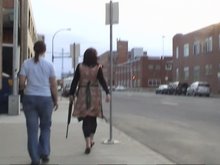
Besides the performances that I write about everyday, there is a rigorous production of other planned and impromptu works that take place undocumented. Most of the works are nomadic and drift through the city at various points in the day. It is hard to locate the works, and often audiences looking for performance actions end up finding residue and traces. (Especially in Emma Waultraud Howes', Juliana Pivato's and Marc Couroux's works).
The invited audience is in most cases not the desired witness/participant for the work. There is a tension played out everyday between the officially published schedule of the festival performances and the unofficial one that changes everyday. What is the artist's obligation to audiences who expect to find performances as “advertised” and then do not? Traditional festivals intend to build audiences by fulfilling the promises of their schedule and programming. In the case of Visualeyez audiences are expected to find both the information and the performances. Indeed, it is through the process of finding the work, either through deliberate searching for it or stumbling upon it through chance encounter and anomaly, that one fulfills the intent of many of the artists here.
Interestingly, the blog is the most constant and stable site for invited audiences to encounter the performances featured in the festival. The artists are very aware that there is a larger audience watching the progress of their works. In morning discussions, we talk about the impact of the blog audience on the works. Even though there are few comments posted in response to the blog, artists appreciate the fact that audiences can access the processual development of their works throughout the ten days of the festival.
Showing posts with label audience. Show all posts
Showing posts with label audience. Show all posts
Friday, May 25, 2007

Monday, May 21, 2007
Sample Kiss, Amber Landgraff

Amber Langraff "Sample Kiss", Photo: anonymous
Amber Landgraff stands outside of The Spa, a beauty salon on Whyte Street. She has set up a portable kiosk stand to display “Amber” a product line of “break up kisses”. As people walk by Amber offers to give people the “ends of relationships” for free. Most people don’t acknowledge her offer and keep walking. One man stops and asks what she is selling. Amber replies in a friendly, yet professionally confident way, that she is offering four different types of break-up kisses, “goodbye kiss, jealous kiss, bitter and unwanted.” He laughs. Then walks away.
I get up from where I sit observing the situation. I approach Amber and ask what it is that she is selling. Her demeanour is approachable and likable, her tone is clear and confident. She repeats the same script, “ I am giving away the ends of relationships. Would you like to try one?” I say “sure” and decide to select the bitter kiss. Amber writes the word “bitter” down on a blank white business card. Then she takes a pink lipstick from the display and applies it to her lips. Looking straight into my eyes, she glares at me while her face slightly contorts, before she says “bitter kiss”. It is a moment when something in our interaction shifts. I laugh a little nervously, a little uncomfortably. I know this sensation, a mix between humiliation and relief. It’s a sensation I have felt before when giving and receiving bitter kisses in public spaces. This sensation shifts quickly to an intellectual realization that this is an action intended to evoke a kind of derive and detournement of social exchanges. I find my own reaction strangely delightful, and I laugh. She kisses the card bitterly as promised, leaves an imprint and then hands it to me. I thank her, not entirely sure why.
Amber offers to give away “the ends of a relationship”, a paradoxical claim that cannot fulfill its premise. The beginning and end of relations are often signified by performative utterances. For instance, the vows of a marriage promise everlasting love, which as we well know, is often compromised. While divorce, the ‘end’ of a relationship, is arguably the initiation of a new type of relation (ie. the ‘ex’, the friend, the co-parent etc). Ritualized events are used to mark beginnings and endings - to mark key moments of relation in time. They are measurements that signify entry into predetermined and recognized forms of relation. Amber’s bitter kiss, given to me in our encounter, was neither a measurable beginning nor ending, our ‘breakup’ is a relationship that is continuing through different forms of encounter.
I would argue that Amber’s kisses are also not free. She offers what appears to be an altruistic and philanthropic exchange with passersby. Like many marketing strategies, corporations and businesses offer their clients free gifts or free use for ‘trying their products’. Inevitably, these ‘free’ gifts work to socially acclimatize clients to the products as a way of insuring future purchases. Does Amber’s kiss oblige me to her somehow? What is it that she gets in exchange for our transaction? I question my own sense of indebtedness to Amber’s kindness and generosity. I am suspicious. Within the flow of capital exchange and the barter system, free gifts and acts of kindness tend to mean that there is something owed later down the line.
In a conversation I had with Amber, she explains her interest in what she sees as ‘the failure of relation’ in this work. She is aware that the intention to do something for free, for the good of people through altruistic gesture is rarely realized. From the performance, it is clear that many participants do not care about the gesture, as they walk by her or walk away from any relation with her (ironically, these passersby have failed to not have a relationship with Amber). Sometimes the affect Amber may hope to evoke is never realized. Amber also raises an interesting key question. What happens when the intention for a performance is conveyed but never realized? This is an aspect of performance that is rarely questioned. The artist’s intention for a work is usually the gauge for determining the success of a work. When there is not a correlation between the intention and the actualization of a work, it is said to fail. This is often the value system used in the art world to assess and conserve performance art works. But how do we account for the multitude of relations and events that occur not as success or failure, predetermined frames of art reference, but outside the conventions that delineate these values of exchange?
There are moments I feel that, as an “invited and knowing audience” it is too easy to fall into the role of a social anthropologist who perceives actions as quantifiable evidence. When observing interventions in public spaces, I try to sit and watch as “a pedestrian on the street,” but this is compromised by the fact that I possess “insider information”. My presence also renders the event more of a spectacle- with the pedestrians unknowingly performing for me and future art audiences through my presence as blogger.
Sunday, May 20, 2007
Evening Presentation, May 20
Tonight’s informal artists’ discussion featured Lori Weidenhammer, Amber Landgraff and Emma Waultraud Howes. All three artists briefly summarized their works that have been actualized over the last three days and raised diverse issues that carried through in the informal discussion.
The problem of a performing for an invited festival audiences was raised through Emma’s series of performances for the project,‘Subtle Architecture’. Many gallery audiences seeking to witness the performances are unable to locate her movements. There is a noticable tension in the desire by audiences to witness the events, and the artist’ desire to challenge such a witnessing. An important question was raised. How can the festival accommodate this “zone of indescernibility” when art’s venues like latitude 53 are obliged to host art “for the public audience”? This question is certainly not a new one, but it continues to impact the presentation and therefore the potential content of works- by its insistence on audience participation. There is an implicit assumption by funding structures that artists need an audience to witness the event, in order to authenticate it as performance or art. This follows the notion of artists as cultural workers who’s role is to speak to “the public”. While this is most certainly a desire and motivation for the production of some site-specific performance works for by artists in the festival, most are questioning the assumptions of how one witnesses a performance and how publics are amorphous and multifaceted.
The notion of exchange with audiences soon followed. If works are not to be exchanged with invited audiences from the festivals, then how does exchange function in such a context?
Questions around problems of documenting are also raised. Key points of concern include:
In what ways does documentation impact the reception of site-specific work?
How might documentation function in duration through time?
How does documentation affect modes of access, encounter and reception with the audience?
How is history and mythmaking of performance events created via documentation?
How the excess of documentation functions in artistic practice?
How is the fragility and shortened life span of electronic media documentation vs analog media impacting performance art practices today?
Interestingly, surveillance as a form of documentation and evidence was not brought up.
(This is an issue particularly relevant to the theme of the city and is present in many works, especially Emma's recent performances.)
The problem of a performing for an invited festival audiences was raised through Emma’s series of performances for the project,‘Subtle Architecture’. Many gallery audiences seeking to witness the performances are unable to locate her movements. There is a noticable tension in the desire by audiences to witness the events, and the artist’ desire to challenge such a witnessing. An important question was raised. How can the festival accommodate this “zone of indescernibility” when art’s venues like latitude 53 are obliged to host art “for the public audience”? This question is certainly not a new one, but it continues to impact the presentation and therefore the potential content of works- by its insistence on audience participation. There is an implicit assumption by funding structures that artists need an audience to witness the event, in order to authenticate it as performance or art. This follows the notion of artists as cultural workers who’s role is to speak to “the public”. While this is most certainly a desire and motivation for the production of some site-specific performance works for by artists in the festival, most are questioning the assumptions of how one witnesses a performance and how publics are amorphous and multifaceted.
The notion of exchange with audiences soon followed. If works are not to be exchanged with invited audiences from the festivals, then how does exchange function in such a context?
Questions around problems of documenting are also raised. Key points of concern include:
In what ways does documentation impact the reception of site-specific work?
How might documentation function in duration through time?
How does documentation affect modes of access, encounter and reception with the audience?
How is history and mythmaking of performance events created via documentation?
How the excess of documentation functions in artistic practice?
How is the fragility and shortened life span of electronic media documentation vs analog media impacting performance art practices today?
Interestingly, surveillance as a form of documentation and evidence was not brought up.
(This is an issue particularly relevant to the theme of the city and is present in many works, especially Emma's recent performances.)
Subscribe to:
Posts (Atom)