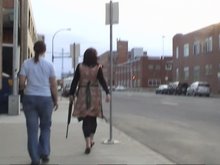
The morning meetings held every other day throughout the festival focus on the problem of documenting. This is a key concern in the festival given the fact that most works are nomadic and do not lend themselves to the same aesthetic preoccupations as staged performance. In the discussions many of the artists voice a desire not to index the events in a moment in time or as evidence of “what happened”.
Often documentation of performance art (or live art) is recorded with video or photography in order to record the so-called original and authentic moment of a performance. Documentation has often been used to legitimize and historicize performance art and function as evidence of activity to funders. The obsessive and excessive presence of video in performance events has now become normalized. The presence of a videographer lurking in the background of performance works, or audience members using camcorders have become conventional props augmenting the performance event.
Our discussions focus on how this performative presence of a documenter (videographer or witness) might be employed in the works of the festival. I ask each artist how I can engage as an audience member and documenter in each of their works. I ask, might it be more advantageous to include documenters in the creative process of the work rather than after the fact, (as is so often the case of performance art festivals). We talk about the process of documentation as being integral to the development and production of some of the works.
As noted in the previous post, the Visualeyez blog is the site of documentation and reflection for a durational audience. By this I mean that audiences will experience the blog through various lenses of time, (Ie. As a current blog and as an archive). The blog extends the potential experiential dimension of the events through time in a very different way than the accidental encounters with the nomadic performance do. Playing with diverse strategies to encounter the audience and for the audience to encounter the creative impulse of the works, many of the artists have created parasitic blogs that reflect on their own processes of creation throughout the festival. (See the links).
Showing posts with label documentation. Show all posts
Showing posts with label documentation. Show all posts
Friday, May 25, 2007

Sunday, May 20, 2007
Evening Presentation, May 20
Tonight’s informal artists’ discussion featured Lori Weidenhammer, Amber Landgraff and Emma Waultraud Howes. All three artists briefly summarized their works that have been actualized over the last three days and raised diverse issues that carried through in the informal discussion.
The problem of a performing for an invited festival audiences was raised through Emma’s series of performances for the project,‘Subtle Architecture’. Many gallery audiences seeking to witness the performances are unable to locate her movements. There is a noticable tension in the desire by audiences to witness the events, and the artist’ desire to challenge such a witnessing. An important question was raised. How can the festival accommodate this “zone of indescernibility” when art’s venues like latitude 53 are obliged to host art “for the public audience”? This question is certainly not a new one, but it continues to impact the presentation and therefore the potential content of works- by its insistence on audience participation. There is an implicit assumption by funding structures that artists need an audience to witness the event, in order to authenticate it as performance or art. This follows the notion of artists as cultural workers who’s role is to speak to “the public”. While this is most certainly a desire and motivation for the production of some site-specific performance works for by artists in the festival, most are questioning the assumptions of how one witnesses a performance and how publics are amorphous and multifaceted.
The notion of exchange with audiences soon followed. If works are not to be exchanged with invited audiences from the festivals, then how does exchange function in such a context?
Questions around problems of documenting are also raised. Key points of concern include:
In what ways does documentation impact the reception of site-specific work?
How might documentation function in duration through time?
How does documentation affect modes of access, encounter and reception with the audience?
How is history and mythmaking of performance events created via documentation?
How the excess of documentation functions in artistic practice?
How is the fragility and shortened life span of electronic media documentation vs analog media impacting performance art practices today?
Interestingly, surveillance as a form of documentation and evidence was not brought up.
(This is an issue particularly relevant to the theme of the city and is present in many works, especially Emma's recent performances.)
Subscribe to:
Posts (Atom)