The morning meetings held every other day throughout the festival focus on the problem of documenting. This is a key concern in the festival given the fact that most works are nomadic and do not lend themselves to the same aesthetic preoccupations as staged performance. In the discussions many of the artists voice a desire not to index the events in a moment in time or as evidence of “what happened”.
Often documentation of performance art (or live art) is recorded with video or photography in order to record the so-called original and authentic moment of a performance. Documentation has often been used to legitimize and historicize performance art and function as evidence of activity to funders. The obsessive and excessive presence of video in performance events has now become normalized. The presence of a videographer lurking in the background of performance works, or audience members using camcorders have become conventional props augmenting the performance event.
Our discussions focus on how this performative presence of a documenter (videographer or witness) might be employed in the works of the festival. I ask each artist how I can engage as an audience member and documenter in each of their works. I ask, might it be more advantageous to include documenters in the creative process of the work rather than after the fact, (as is so often the case of performance art festivals). We talk about the process of documentation as being integral to the development and production of some of the works.
As noted in the previous post, the Visualeyez blog is the site of documentation and reflection for a durational audience. By this I mean that audiences will experience the blog through various lenses of time, (Ie. As a current blog and as an archive). The blog extends the potential experiential dimension of the events through time in a very different way than the accidental encounters with the nomadic performance do. Playing with diverse strategies to encounter the audience and for the audience to encounter the creative impulse of the works, many of the artists have created parasitic blogs that reflect on their own processes of creation throughout the festival. (See the links).
Friday, May 25, 2007

Thoughts On "The Audience"
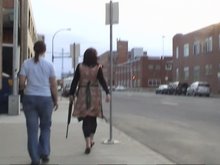
Besides the performances that I write about everyday, there is a rigorous production of other planned and impromptu works that take place undocumented. Most of the works are nomadic and drift through the city at various points in the day. It is hard to locate the works, and often audiences looking for performance actions end up finding residue and traces. (Especially in Emma Waultraud Howes', Juliana Pivato's and Marc Couroux's works).
The invited audience is in most cases not the desired witness/participant for the work. There is a tension played out everyday between the officially published schedule of the festival performances and the unofficial one that changes everyday. What is the artist's obligation to audiences who expect to find performances as “advertised” and then do not? Traditional festivals intend to build audiences by fulfilling the promises of their schedule and programming. In the case of Visualeyez audiences are expected to find both the information and the performances. Indeed, it is through the process of finding the work, either through deliberate searching for it or stumbling upon it through chance encounter and anomaly, that one fulfills the intent of many of the artists here.
Interestingly, the blog is the most constant and stable site for invited audiences to encounter the performances featured in the festival. The artists are very aware that there is a larger audience watching the progress of their works. In morning discussions, we talk about the impact of the blog audience on the works. Even though there are few comments posted in response to the blog, artists appreciate the fact that audiences can access the processual development of their works throughout the ten days of the festival.
The invited audience is in most cases not the desired witness/participant for the work. There is a tension played out everyday between the officially published schedule of the festival performances and the unofficial one that changes everyday. What is the artist's obligation to audiences who expect to find performances as “advertised” and then do not? Traditional festivals intend to build audiences by fulfilling the promises of their schedule and programming. In the case of Visualeyez audiences are expected to find both the information and the performances. Indeed, it is through the process of finding the work, either through deliberate searching for it or stumbling upon it through chance encounter and anomaly, that one fulfills the intent of many of the artists here.
Interestingly, the blog is the most constant and stable site for invited audiences to encounter the performances featured in the festival. The artists are very aware that there is a larger audience watching the progress of their works. In morning discussions, we talk about the impact of the blog audience on the works. Even though there are few comments posted in response to the blog, artists appreciate the fact that audiences can access the processual development of their works throughout the ten days of the festival.
Thursday, May 24, 2007
Common Ground, Joshua Schwebel

Common Ground, Joshua Schwebel Photo: Emma Waltraud Howes
To walk in another’s shoes is an empathetic gesture. Joshua Schwebel takes this anecdote to its literal extreme and constructs wearable sculptures made of found shoes that are conjoined at the sole. Josh invites people to wear the shoes and engage with him in various activities such as walking, dancing and exercising. He also invites people to exchange their shoes with his own and walk though the city.
I meet up with Josh in an exercise gym in the downtown core. It is a trendy and spacious training centre. Josh meets with the manager, tells her we are from Visualeyez, and asks if we can exercise on the treadmill wearing the shoes. He notes that we will be videotaping. Somewhat surprisingly, the manager doesn’t find his request strange and generously agrees to let us use the gym as we see fit, free of charge.
This is my second time participating in Josh’s project. Last Saturday I danced with Amber, and also in a triangular connection with Josh and Amber at the Roost Club. Today I try on a different pair of conjoined shoes with Josh. We sit on exercise bikes and attempt to push the pedals wearing absurdly inappropriate shoes.
Common Ground, Joshua Schwebel
Video Tagny Duff
When I push forward, his foot resists my force. My other foot struggles to maintain balance. I try to relax into a rhythm with the least resistance. But even then, Josh’s foot slips and throws us both off balance again. I concentrate on finding the movement of his foot. I wait. I let go of waiting. Then, somehow we feel the movement continue and we are cycling. Something has happened in the lag between feeling like falling off the bike onto the cement floor below, and falling into an unfamiliar sense of balance. This balance relies on interdependence with Josh’s movement. The sense of ground shifts. My own internal sense of balance and horizon line is fundamentally reconfigured. I feel like I am simultaneously falling and sitting.
Josh is concerned with the often-imperceptible negotiations that we encounter between self and other at the level of these physicality-challenging encounters. Proprioception—the internal sense of the body’s movements correlating to its external positioning through muscular sensation - is an interest of Josh’s, and is the sense that he activates in these encounters. The site where the events occur are not as important as are the sensations experienced between Josh and the people wearing the shoes. It is the sense of struggle, the negotiations of dependence and interdependence that produce discomfort, that are evoked. The lag becomes a site of encounter. This lag is in-between the time when one’s body moves with another and when one consciously is aware of the movement.
Josh’s work suggests that the relations we encounter and produce within the city are not external from and of the body. The city is not only an external structure that we wear on our bodies, but it is one that our bodies create in relation. In this case, my relation to the city is created through the movements of our interdependent bodies. I think of Lori Weidenhammer’s ongoing interventions from the “Madame Beespeaker Project”, and recall her explanation of how bees navigate their relations between each other and the hive through the use of pheromones. I think of how birds flock together to form interdependent migration patterns. Josh’s piece also alludes to the potential for humans to navigate with one another through the city via the muscular dimensions of the human body. In his presentation last night, he noted how his physical orientation and sense of balance shifts when encountering a new city, or a new acquaintance. Then the balance stabilizes and the ground solidifies under his feet. Between these disorienting (and uncomfortable) shifts, he learns to navigate. Common Ground facilitates the potential for participants to move through the city as much as create new ways of moving the city.
Wednesday, May 23, 2007
Drinking In The Kitchen, Irene Loughlin

Irene Loughlin, Drinking in the Kitchen Video still: Tagny Duff
We enter into the kitchen of Latitude 53 and find a place to sit on the floor. Irene Loughlin stands behind the table and grabs a bottle of dark scotch whisky. She proceeds to take copious amounts of drink from the bottle. Then she sits down next to the kitchen table. Slowly she sinks into the chair and lays her upper torso across the table.
This is a semiotics of the kitchen – of sorts.
However, it is not the same kind of Semiotics of the Kitchen performed by Martha Rosler on video in 1975. Whereas Rosler performs (while deconstructing) the engendering of gender in language through kitchen objects, Loughlin performs the excess of the sign experienced in the throws of drunkenness. She makes martinis and margaritas to the rhythm of Rosler’s video which plays as a loop on a VHS monitor placed on the kitchen table. The two performances collide and converse. At moments, Rosler’s articulation of “fork” and motions to jab the air is juxtaposed to Irene’s chopping of lemons with a butcher knife. The audience laughs at Rosler’s exaggerated mocking gesture and simultaneously grimaces nervously at Irene’s vigorous cutting motions. The collision between Rosler’s and Loughlin’s actions produce slippage and breakdown of language. I feel it. So does the audience as Irene serves us martinis and margaritas for the hour long performance.
I watch as Irene stumbles around the kitchen. The ice dispenser on the fridge is stuck. So she walks back to the sink and grabs some ice from the bag. She proceeds to put the ice and vodka in a martini shaker and shakes vigorously. Then she pulls at the lid to open it. But it’s stuck. She tries everything to open it. It won’t open. Members from the audience offer to help. They can’t open it either. Finally Todd leaves the gallery with the shaker and comes back with it opened. Irene proceeds to make martinis and adorns them with olives and lemons. She walks around the table and hands them to people who gratefully accept them.
She pours the ice into a blender and fumbles to switch it on. The smell of burning quickly fills the kitchen. Someone from the audience suggests she put some alcohol in the blender. It needs liquid, otherwise it might burn up the motor. She pours too much vermouth in. Everyone groans. The pouring and mixing of the margaritas continues to intermix with the rhythm of Rosler’s voice “ ladle”, “knife” and “apron”. I am offered a margarita and begin to drink it, even though I am video taping.
The laughter amplifies and gets increasingly louder through the hour of drinking and watching Irene make the drinks. We are complicit and participate in her drunken, clumsy stupor. This kind of social drinking is acceptable. No-one in the room turns the offer for a drink down. The drinks are too strong—too much vermouth and vodka—mixed with strange, horrific garnishes like cucumber, creamcheese, donuts and lemon.
When all the liquor is gone, Irene stops her work. She takes a quick swig of the bottle. Before it disappears, a slight foam appears in the bottle. I realize that it is coke in the bottle. Irene is performing her drunkenness. Everyone in the room, on the other hand, is noticeably intoxicated.
Irene grabs a gun.
There is more laughing. We follow Irene out of the kitchen to the street. She walks in her high heels and apron, with determination ahead of the crowd of people following her. As we walk past a bar, one guy sees us and says, “If you were a native and carrying a gun, the cops would be here in two seconds”.

Irene Loughlin, Drinking in the Kitchen
Video Still: Tagny Duff
We reach a parking lot. Todd, Juliana and other people set up a shooting range against the brick wall of a building. Irene watches intently as 12 cans of beer are shaken and stacked on top of each other. The beer cans tumble, and have to be reset. We wait.
I hear the sound of cop sirens. They grow louder. I look at Irene standing in the parking lot holding the gun, and notice the nervousness in the crowd. The sirens get louder. I wonder what will happen when the cops come. Who will the take the fall for possession of a firearm- Irene or the gallery? What about the public drunkenness and consumption of alcohol? Will the cops let it slid because we are participating in art, which is often the case? I wonder at the complicity we engage in. No-one interferes with Irene’s excessive alcohol consumption. No-one in the audience or on the street stops Irene from walking down the sidewalk with a gun. Unlike pedestrians in the street, we, the invited audience, know this is a performance, and want it to “go well”.

Irene Loughlin, Drinking the Kitchen
Video Still: Tagny Duff
The sirens never arrive. Irene turns her attention to the beer cans and takes aim. She shoots. She’s a straight shooter. All the cans are marked off, and one by one geysers of beer fountain. The crowd is relieved. We clap.
Irene’s staging of drunkenness in the intimate space of Latitude’s kitchen and its spillage on the streets addresses the affects of private and socially legitimized forms of substance abuse. Loughlin reverses the audience-performer role, through the manipulative strategies often employed by social drinkers. “I will drink if you will”. “I will join you in a drink”. But the drink is more than a drink. In this case, the exchange drinking is in excess of its own signification of “alcoholism” or “addiction”.
To join in a drink is potentially as invigorating as it is dangerous. Like Irene, Brian Jungen also brought beer to an art audience in a recent piece Beer Cooler (2002) to “share” in a friendly exchange of “spirits”. The pretence of drinking as a form of friendship may simultaneously be read as a ritual of territorialization. Irene’s friendliness with the audience was similarly a strategic ploy. Getting the audience drunk shifted the terrain of the performance. The audience welcomed her generous gift. Yet her generosity of gift was given on false pretence, she was sober and intended the audience to experience the effects of intoxication. We followed along with her offer and directions. When she takes out a gun, we don’t doubt her motivations. We know that she will be firing the gun at some point because the program said so. But we don’t know how or when or even why, but we go along with it. We trust her, even as we walk down the street with an armed weapon, albeit only a pellet rifle.
Again, I think of the guy at the bar who stated that Native people would not be so invisible when carrying a gun. Irene knows this. The performance of shooting is a direct reference to Lawrence Paul Yuxweluptun’s performance “Shooting the Indian Act” presented in Surrey, England. In this piece Yuxweluptun shoots a paper copy of the Indian Act to protest the ongoing effects of the legislation on Indigenous People. Irene, similarly shots at cans of beers to reject the gift of alcohol and the legacy of ritualized dependency and consumption of intoxications. Within this legacy, the intimate space of ones own kitchen has the potential to become a public shooting range fraught with undercurrents of violence. Casual exchanges between friends and strangers become suspect. Micro-exchanges of these gifts (bottles of wine) are to be received with some trepidation. The semiotics of Irene’s kitchen is overfull. They spill out of the bullet-ridden holes of language, urban dwellings and city streets.
Tuesday, May 22, 2007
The Madame Beespeaker Project, Lori Weidenhammer

The Beespeaker Project by Lori Weidenhammer
Video Still: Tagny Duff
The urban planning of Edmonton has noticeably reduced allocation of green space in the downtown core. Across from Edmonton City Hall there used to be a large green park where workers in the surrounding area would go to have their lunch. Now it’s a huge square floor of cement that is a parking lot for pedestrians. Workers sit and eat their lunches on benches and cement chairs. Security guards watchfully patrol the perimeters. On the far side of this urban park, a small patch of green space remains as a fragmented trace of what is buried under the clean smooth surface. A fence surrounds it and a sign says “stay out”. It is intended to deter tent squatters and protesters who are currently squatting in city parks to illuminate the growing issue of increased housing costs, underemployment and homelessness in the city.
Protesters, the underemployed, and the homeless are not the only ones being restricted from accessing green space. So are honeybees, now rapidly disappearing due to reduced natural habitat. Bees are often observed and symbolized as functioning within complex communities and systems of mathematic, spiritual, scientific and sociological interest. The movement of workers in the city is sometimes likened to a hive. Human social relations are likened to the behaviour of “worker bees”. Human cellular processes are founded on the notion of the cells of honeycombs. And, the process of pollination is necessary for the evolution of the world’s food crops. More than a metaphor or a symbol of vitality, the hive and the honeybee is integral to life processes. The relation between the reduction of green spaces, beehives and shelter was a poignant metatext in the site.
Lori Weidenhammer draws our attention to how urban planning affects the eco habitat and the necessary symbiotic relation between humans and bees. Dressed as a cross between a beekeeper, biologist, spiritualist and anthropologist, Weidenhammar embodies the persona of Madame Doolittle, a beespeaker who has acquired the scientific knowledge and developed extra-sensory perceptions to communicate with bees. When people approach the kiosk Weidenhammer speaks openly and matter-of-factly. She invites people to design, stamp and write a note to the bees on a tag card, which she then pins on to a large hive structure located next to the kiosk table that displays various honeybee paraphernalia. There are tags from the previous performance she did in Saskatoon and others collected from a previous site in Edmonton (The Strathcona Market). The tags function as prayers from people of all ages sending well wishes to the bees.
The presentation of this intervention is strangely endearing and the sincerity is a little jarring. Madame Beespeaker/Weidenhammer speaks earnestly about the plight of honeybees. The exchange of conversation is relaxed, as she talks about the social, scientific, educational and spiritual dimensions of the bees to people. There is no pretension, no meta-text. She makes it clear to people that the kiosk is a performance art project. Signs on the kiosk clearly state this fact.
In the context of this location, the kiosk functions as an information display centre on both the honeybee and performance art, as much as a kind of psychic booth as an art fair. The dome tent with the tags, intended to represent a hive, in this case evokes the tent squats. Interestingly, the interior of the dome/hive is not accessible and we are invited to read the well wishes only on the exterior of the hive. Neither bees nor humans can enter “the hive,” or attain shelter from the elements in this context of the park and the performance props.
This disjunction evokes the growing phenomenon called Colony Collapse Disorder, where the occupants of beehives abandon the queen bee and the hive. One hypothesis proposed is that the recent spike in cellphone use is to blame for the bees’ disappearance. Theories suggest that satellite signals cause interference that prevents honeybees from finding their way back to the hive. It may not be the symbolic and physical barriers that prevent the bees or tent protesters from finding “the hive” or shelter. Weidenhammer’s performance alludes to the fact that imperceptible fields (electromagnetic, psychic, chemical and otherwise) affect the environmental and social habitat of both bees and humans.
Monday, May 21, 2007
Sample Kiss, Amber Landgraff

Amber Langraff "Sample Kiss", Photo: anonymous
Amber Landgraff stands outside of The Spa, a beauty salon on Whyte Street. She has set up a portable kiosk stand to display “Amber” a product line of “break up kisses”. As people walk by Amber offers to give people the “ends of relationships” for free. Most people don’t acknowledge her offer and keep walking. One man stops and asks what she is selling. Amber replies in a friendly, yet professionally confident way, that she is offering four different types of break-up kisses, “goodbye kiss, jealous kiss, bitter and unwanted.” He laughs. Then walks away.
I get up from where I sit observing the situation. I approach Amber and ask what it is that she is selling. Her demeanour is approachable and likable, her tone is clear and confident. She repeats the same script, “ I am giving away the ends of relationships. Would you like to try one?” I say “sure” and decide to select the bitter kiss. Amber writes the word “bitter” down on a blank white business card. Then she takes a pink lipstick from the display and applies it to her lips. Looking straight into my eyes, she glares at me while her face slightly contorts, before she says “bitter kiss”. It is a moment when something in our interaction shifts. I laugh a little nervously, a little uncomfortably. I know this sensation, a mix between humiliation and relief. It’s a sensation I have felt before when giving and receiving bitter kisses in public spaces. This sensation shifts quickly to an intellectual realization that this is an action intended to evoke a kind of derive and detournement of social exchanges. I find my own reaction strangely delightful, and I laugh. She kisses the card bitterly as promised, leaves an imprint and then hands it to me. I thank her, not entirely sure why.
Amber offers to give away “the ends of a relationship”, a paradoxical claim that cannot fulfill its premise. The beginning and end of relations are often signified by performative utterances. For instance, the vows of a marriage promise everlasting love, which as we well know, is often compromised. While divorce, the ‘end’ of a relationship, is arguably the initiation of a new type of relation (ie. the ‘ex’, the friend, the co-parent etc). Ritualized events are used to mark beginnings and endings - to mark key moments of relation in time. They are measurements that signify entry into predetermined and recognized forms of relation. Amber’s bitter kiss, given to me in our encounter, was neither a measurable beginning nor ending, our ‘breakup’ is a relationship that is continuing through different forms of encounter.
I would argue that Amber’s kisses are also not free. She offers what appears to be an altruistic and philanthropic exchange with passersby. Like many marketing strategies, corporations and businesses offer their clients free gifts or free use for ‘trying their products’. Inevitably, these ‘free’ gifts work to socially acclimatize clients to the products as a way of insuring future purchases. Does Amber’s kiss oblige me to her somehow? What is it that she gets in exchange for our transaction? I question my own sense of indebtedness to Amber’s kindness and generosity. I am suspicious. Within the flow of capital exchange and the barter system, free gifts and acts of kindness tend to mean that there is something owed later down the line.
In a conversation I had with Amber, she explains her interest in what she sees as ‘the failure of relation’ in this work. She is aware that the intention to do something for free, for the good of people through altruistic gesture is rarely realized. From the performance, it is clear that many participants do not care about the gesture, as they walk by her or walk away from any relation with her (ironically, these passersby have failed to not have a relationship with Amber). Sometimes the affect Amber may hope to evoke is never realized. Amber also raises an interesting key question. What happens when the intention for a performance is conveyed but never realized? This is an aspect of performance that is rarely questioned. The artist’s intention for a work is usually the gauge for determining the success of a work. When there is not a correlation between the intention and the actualization of a work, it is said to fail. This is often the value system used in the art world to assess and conserve performance art works. But how do we account for the multitude of relations and events that occur not as success or failure, predetermined frames of art reference, but outside the conventions that delineate these values of exchange?
There are moments I feel that, as an “invited and knowing audience” it is too easy to fall into the role of a social anthropologist who perceives actions as quantifiable evidence. When observing interventions in public spaces, I try to sit and watch as “a pedestrian on the street,” but this is compromised by the fact that I possess “insider information”. My presence also renders the event more of a spectacle- with the pedestrians unknowingly performing for me and future art audiences through my presence as blogger.
Sunday, May 20, 2007
Evening Presentation, May 20
Tonight’s informal artists’ discussion featured Lori Weidenhammer, Amber Landgraff and Emma Waultraud Howes. All three artists briefly summarized their works that have been actualized over the last three days and raised diverse issues that carried through in the informal discussion.
The problem of a performing for an invited festival audiences was raised through Emma’s series of performances for the project,‘Subtle Architecture’. Many gallery audiences seeking to witness the performances are unable to locate her movements. There is a noticable tension in the desire by audiences to witness the events, and the artist’ desire to challenge such a witnessing. An important question was raised. How can the festival accommodate this “zone of indescernibility” when art’s venues like latitude 53 are obliged to host art “for the public audience”? This question is certainly not a new one, but it continues to impact the presentation and therefore the potential content of works- by its insistence on audience participation. There is an implicit assumption by funding structures that artists need an audience to witness the event, in order to authenticate it as performance or art. This follows the notion of artists as cultural workers who’s role is to speak to “the public”. While this is most certainly a desire and motivation for the production of some site-specific performance works for by artists in the festival, most are questioning the assumptions of how one witnesses a performance and how publics are amorphous and multifaceted.
The notion of exchange with audiences soon followed. If works are not to be exchanged with invited audiences from the festivals, then how does exchange function in such a context?
Questions around problems of documenting are also raised. Key points of concern include:
In what ways does documentation impact the reception of site-specific work?
How might documentation function in duration through time?
How does documentation affect modes of access, encounter and reception with the audience?
How is history and mythmaking of performance events created via documentation?
How the excess of documentation functions in artistic practice?
How is the fragility and shortened life span of electronic media documentation vs analog media impacting performance art practices today?
Interestingly, surveillance as a form of documentation and evidence was not brought up.
(This is an issue particularly relevant to the theme of the city and is present in many works, especially Emma's recent performances.)
The problem of a performing for an invited festival audiences was raised through Emma’s series of performances for the project,‘Subtle Architecture’. Many gallery audiences seeking to witness the performances are unable to locate her movements. There is a noticable tension in the desire by audiences to witness the events, and the artist’ desire to challenge such a witnessing. An important question was raised. How can the festival accommodate this “zone of indescernibility” when art’s venues like latitude 53 are obliged to host art “for the public audience”? This question is certainly not a new one, but it continues to impact the presentation and therefore the potential content of works- by its insistence on audience participation. There is an implicit assumption by funding structures that artists need an audience to witness the event, in order to authenticate it as performance or art. This follows the notion of artists as cultural workers who’s role is to speak to “the public”. While this is most certainly a desire and motivation for the production of some site-specific performance works for by artists in the festival, most are questioning the assumptions of how one witnesses a performance and how publics are amorphous and multifaceted.
The notion of exchange with audiences soon followed. If works are not to be exchanged with invited audiences from the festivals, then how does exchange function in such a context?
Questions around problems of documenting are also raised. Key points of concern include:
In what ways does documentation impact the reception of site-specific work?
How might documentation function in duration through time?
How does documentation affect modes of access, encounter and reception with the audience?
How is history and mythmaking of performance events created via documentation?
How the excess of documentation functions in artistic practice?
How is the fragility and shortened life span of electronic media documentation vs analog media impacting performance art practices today?
Interestingly, surveillance as a form of documentation and evidence was not brought up.
(This is an issue particularly relevant to the theme of the city and is present in many works, especially Emma's recent performances.)
Subscribe to:
Posts (Atom)